
Hydraulic vs Cable Boat Lifts

Hydraulic boat lifts offer faster and easier operation compared to cable lifts, making them a popular choice. Cable lifts are durable and require less maintenance. They are generally more affordable.

Fully Hydraulic Boat Lifts

A fully hydraulic lift is a modern type of lift that uses hydraulics to lift your boat. Hydraulic systems use pressurized fluid to transfer power and movement. In a hydraulic boat lift, the system is comprised of hydraulic cylinders connected to a control system and pump. The pump sends fluid into the cylinders, which move up or down to raise or lower the boat.

Fully hydraulic lifts are typically constructed as cantilever lifts, omitting the use of upper beams or cables. They can be installed as low-profile lifts with a shallow water kit. The cantilever style enabling easy access to the boat from the pier or loading dock. With their ability to handle heavy loads and fast speeds, hydraulic lifts are an ideal choice for large boats.

Faster:

Hydraulic lifts use hydraulic fluid to lift the boat, making them faster and easier to operate than cable lifts.

Higher Lifting Range:

Some hydraulic lifts can lift boats higher than cable lifts, offering greater versatility in water depth and boat size.

Maintenance:

Hydraulic lifts require regular maintenance to ensure the hydraulic fluid is clean and the system is functioning properly.

Perform boat lift battery maintenance:

  • Inspect for damage regularly
  • Clean battery terminals
  • Check voltage
  • Keep the battery charged

Cable Boat Lifts

A cable lift is a traditional type of boat lift that uses cables and pulleys to lift your boat. The cables are attached to the four corners of a cradle or platform that supports your boat. The cables are wound around a drum that can be driven by a manual wheel or an electric motor. When the motor rotates the drum, the cables pull the cradle up or down along the vertical corner posts.

Cable lifts are available as vertical or cantilever. Cable lifts, regardless of the type, can support boats of different shapes and sizes, including pontoons and fishing boats.

Less Expensive:

Cable lifts are generally more affordable than hydraulic lifts, making them a more budget-friendly option.

Durable:

Cable lifts are known for their durability and long-term reliability, with minimal maintenance required.

Slower Operation:

Cable lifts are generally slower to operate than hydraulic lifts, as they rely on a motor to pull the cable.

Water Depth:

Most cable lifts are designed to work well in shallow water.

Combination Hydraulic / Cable Lifts:

The combination hydraulic / cable lift utilizes hydraulic power to pull cables, rather than winding them around a drum. This reduces cable wear and maintenance. Less cable wear results in longer cable life, lowering the need for replacement.


Factors to Consider in Wisconsin

Water Fluctuation:

Wisconsin lakes and waterways experience significant water level fluctuations. This can affect the type of lift to choose.

Wave Action:

How wave action can affect boat lifts:

  • Stress on cables: High waves can increase stress on boat lift cables, potentially causing them to weaken and even sever.
  • Boat movement: Waves hitting the bottom of the boat can cause it to lift and fall back onto the rack.
  • Overloading the lift: Storms can cause water to accumulate on the boat, potentially overloading the lift’s capacity.


Ultimately, the best choice for a boat lift depends on your specific needs, budget, and the location of your dock. Consider factors like water depth, boat size, and desired speed and ease of operation when making your decision. Contact Pier & Waterfront Solutions for assistance selecting the right system for you.

Jet Ski Lift – Spring Maintenance Guide (New)

Jet Ski Lift – Spring Maintenance Guide

Jet Ski Lift – Yearly Maintenance Guide

Your Jet Ski Lift requires simple spring maintenance so you can enjoy the summer season.  Don’t ignore your jet ski lift if you want to prolong its life.  This guide will help you.
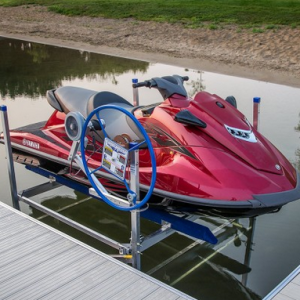
 
ShoreMaster Vertical Jet Ski Lift

ShoreMaster Vertical Jet Ski Lift


Here’s a list of things to check:

  • Inspect the jet ski lift before it goes into the water. Look for worn parts and loose bolts, etc.  Tighten or replace as needed.
  • It’s extremely important to check the cables for corrosion or fraying, Replace as needed.
  • For electric powered jet ski lifts, reattach the battery.
  • If the electric motor uses a rubber friction wheel to drive the handwheel, rub the friction wheel with a clean, coarse rag to remove any residual dirt accumulated over the winter.
  • Check the bearings for any noise and proper operation.
  • Examine inside the rack frames for any sand or vegetation packed into the tubes. Remove these before you use the lift.
  • Check any carpeted bunks for damage.
  • Check all pulleys and other wearable parts for damage. On older models, with plastic pulleys, rotate the pulleys by hand to look for cracked or broken edges.  Replace if damaged.

What else can I do?

  • Apply NO grease to the pulleys as this will allow sand and dirt to accumulate and wear the parts out faster.
  • Ensure that the lift moves freely up & down without binding or straining.  Remember to maintain tension on the cables when lowering the lift rack.  This prevents backlash on the winch. 
  • Make sure the cable winds smoothly and in even rows so that proper memory is maintained.
  • Use leather gloves and face/eye protection if reattaching a bungee cord on a friction drive motor. If the cord slips out of your hands the results can be painful.
  • All cables should have a quick spray of penetrating oil applied to them. The main winch cable including on the cable wrapped around the winch drum.
  • DO NOT APPLY any oil inside the winch mechanism itself – only on the cable.
  • Is it time to replace the carpet on the lift bunks?  Consider replacing them with maintenance-free vinyl bunks?

 Get ready for Summer fun.

 Remember
 Pier & Waterfront Solutions (PWS) specializes in all ShoreMaster docks, lifts, and accessories.
 
Located in the center of Door County at 7325 St Hwy 57, just south of Sturgeon Bay at the intersection of Idlewild Road.  We are 1 mile North of Hwy 42 (County MM).  Our staff looks forward to serving all of your waterfront needs year round.
 
Equally important, if you found this article helpful –  Go to “NEWS” on any page of our website for a complete list of articles These articles are meant to keep you informed on the latest product information and maintenance issues
 
The wide variety of articles on dock and boat lifts issues will answer many of your questions.   PWS believes that an informed consumer makes better decisions.
 
Call Jerry at 920-493-4404 or Email Jerry@wisconsinpws.com for more information.