Sep 14, 2021
Are you a Pro with a Pontoon Boat?
Pontoon boats are a relaxing way to enjoy boating any season of the year.
It’s Fall, and there are still days when you will wish you could be out on a pontoon boat. It might be a little cooler, but after the hot summer, it will be refreshing.
Pontoon Boats are unique
Pontoon boats have their own style with many amenities available. These boats are different in many ways from a normal powerboat. Handling them is another animal to tackle. Check out this article to get the most use of your pontoon boat.
Docking and Undocking
Pontoon boats leave the dock like any other vessel on the water. Yet, their body shape creates more surface area for the wind to push around. It amounts to a “giant sail.”, the tubes and vertical fences found around the deck act as a sail.
Adding to that difficulty are the boat tubes, which provide your floatation. Large gusts of wind are your mortal enemy. They can knock you off course on the water. The ability to push your pontoon into other boats means you need to know how to handle a pontoon boat. Plus, you must have stellar insurance coverage. SEE
To counter the winds, you have to be aware of them at all times. The pontoon boat’s secret is its exceptional control when used with short bursts of power. Regardless of what type of boat you use, idle the engine and point the motor in the direction you want to go. Then shift into gear. Next, use short bursts of power as you steer the boat. Before you know it, you’ll be out of the dock.
You’ll use the same understanding of the wind and maneuvers when heading back into the marina. Docking any powerboat (pontoons included) requires a little more side-to-side motion. You can learn more about these actions via this link.
Beaching
Beaching or mooring your boat to swim is half the fun of boating, no matter what type of vessel you own. People love beaching their boats to explore islands or soak up the sun. Luckily, both are simple processes and the same for every type of powerboat.
Start by traveling slow when you hit shallow waters, so you don’t damage your motor. Beaching requires you to push the front end of your vessel onto land. Do this carefully to prevent damage to the tubes.
Don’t head onto the beach too far; allow enough room to spin the boat around out into the water using the motor.
For mooring, make sure you have the proper tools to secure your boat via the anchor. Pontoon boats are more buoyant, so use fenders to protect your boat from other vessels.
Turning and Handling
Pontoon boats soar across the water, which makes handling them a ton of fun. Before you lose yourself in the moment, remember that there are no lanes out on the water. Always check your surroundings before making a turn or spinning your boat around.
With that safety tip in mind, you’re ready to tackle the water. Pontoon boats are very stable. You don’t have to worry about flipping or rolling the boat over in normal conditions.
But rough waves and tight turns mean you can’t rule out the possibility. Still, it isn’t much of a concern for the modern pontoon boat.
You do have to worry about causing the propeller to leave the water when making a tight turn. You can either back off of the turn, deaccelerate or trim the engine downwards to remedy the issue. When making sharp turns, equipment and people on your deck are likely to be tossed to one side depending on the speed. Do they have life preservers?
Acceleration
Once you hit open waters, you’re ready to pick up speed. Don’t treat your pontoon boat like a race car, though. Instead, speed up steadily until you reach your desired speed. Keep in mind that the bow will level out, which means you’ll need to trim the engine if you want more speed.
Your engine might rise too far out of the water as you speed up. That’s normal and easy to fix by trimming the motor. Your boat may slow down, and you’ll hear a howling sound near the propeller. Or, the boat will lose a little stabilization when this happens.
Keep in mind that every boat comes with a manufacturer’s recommendation for top speeds or RPM. Most recommend 75% of fully open throttle. It helps to read up on this statistic before pushing your boat to its limits. Use less throttle for more fuel efficiency.
Keep in mind that more crowded waters demand slower speeds. There are rarely legal speed limits on open water, so be mindful of other boaters in the area. Keep an eye out for swimmers as you approach other boats or the shoreline.
Stability Tips in Rough Waters
A pontoon boat handles well, even in rough water, thanks to its dual or triple hull design. Yet, even with the added help, you need to drive a pontoon boat carefully in these conditions.
Experienced boaters recommended that you keep an even load on board. To do this, you must include both objects and passengers. When rough waters arise, make sure your passengers know to even out their weight on deck and sit down. Don’t forget to make them wear life preservers for their safety. The larger your boat, the easier this is to maintain.
Try to avoid heading straight into giant waves. Excessive splashing could damage the electronics in your boat if they take on water. If you must head nose-first into oncoming waves, trim the engine down to help keep the boat’s nose/bow upward. Otherwise, take the waves at a 30 to 40-degree angle.
Finally, sports handling packages are an enormous benefit here. These include better nosecones, power-assisted steering, and higher horsepower to combat choppy waters.
Become a Pro
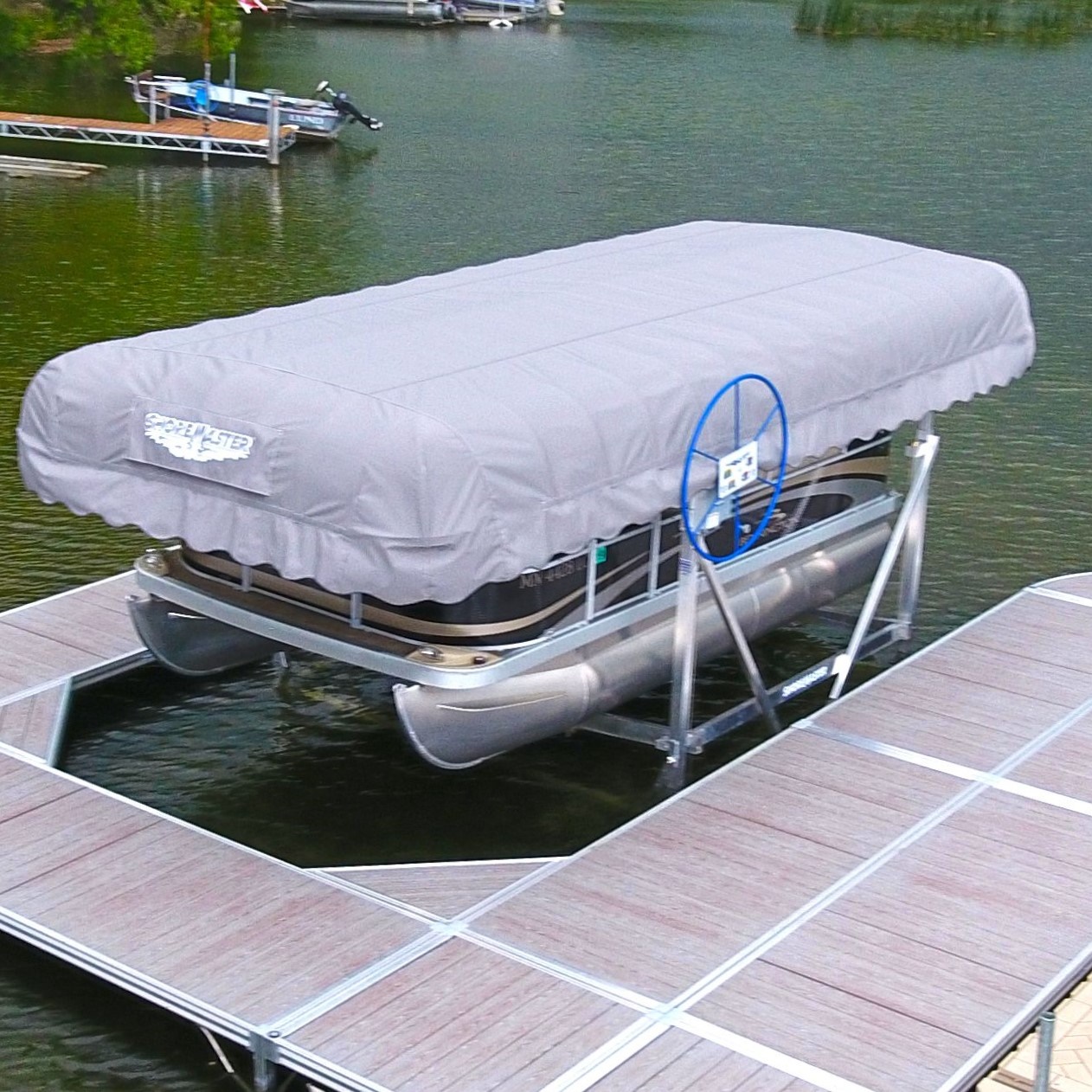
Pontoon Boat Lift
That means don’t head out onto the water when you know a storm is on the way. A pontoon boat is an investment you don’t want to risk for a few more minutes of fun. If inclement weather strikes, head back to the dock and put your boat back on your lift.
Where is Pier & Waterfront Solutions?
Located at 7325 St. Hwy 57, it’s 3 miles south of Sturgeon Bay and 1 mile past the intersection of Cty MM (heading north). Look on the right side, one mile north, at the next corner (Idlewild Road and Hwy 57).
For your protection PWS implemented these preventive measures:
1. Conducting as much business as possible by email, text, or phone.
2. Site visits will continue. When in-person contacts are necessary, we will follow “social distancing” guidelines.
3. Our display yard is always open for you to examine at your leisure. All displays have a numbered, red tag on them. If you want more information or pricing, please reference that number.
Thank you for allowing us to work with you.
YES – PWS is OPEN and waiting for you!
Please call, message, or email PWS with any questions.
Let’s all stay safe!
Sep 7, 2021
SUMMER HAS ENDED
Summer for many people has ended. It’s a sad time for many people. People are heading home. Many families have to get back for school for the kids and can only come back on weekends. Still, there will be some great days left this Fall.
Many of our customers are from out of state. In fact, we have customers from almost ALL the United States. They return each year to enjoy some of our great Wisconsin weather. The size of the crowds will begin going down after Labor Day.
Have no FEAR! Spring is just a couple of months away!
But still, it’s a sad time for many people. Our Chicago and Minnesota customers are among the saddest at this time of the year. Why? They face another year of being defeated by the Packers.
Who else faces problems at this time of the year?
Another group is people with storm-damaged equipment. The Fall storms get stronger in September and October. That’s why we move as fast as we can to get to your location to safeguard your equipment by removing them for the year. The freezing water doesn’t help either.
If you have damage to your equipment please call Jerry @ 920-493-4404.
Not using your docks and lifts anymore this year?
It’s a good idea to drop Keri, our Service Manager, a line letting her know you are ready to be removed. Give her a date when your canopy will be down and your boat stored for the year. Email your message to Keri@wisconsinpws.com. She will put you on the schedule.
It’s particularly tough this year for our crews. One of the dealers in Door County closed expectantly before Memorial Day. Our teams will be working longer hours to adjust to the influx of new customers. As the days get shorter, they will be working by their headlights to meet the schedule.
Four things you should know about fall storms:
- PWS will assist you if a storm damages your equipment. We prepare Free estimates to cover your damage. Insurance companies then use the estimates to prepare a settlement for you.
- We recommend you read this article before talking to the insurance company. Take pictures of all the damage. The more images, the better.
- PWS can also salvage your equipment and make winter repairs, so you are ready to go in Spring.
- PWS will move your equipment to another location if you sold it or bought another property.
PROPERTY DAMAGE?
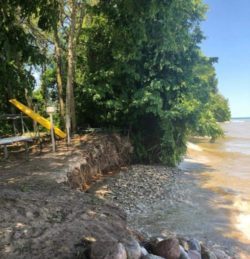
Shoreline Erosion
Do you have property damage, eroded beaches, and lawns? Don’t forget, Pier and Waterfront Solutions has a complete rip rap service available. We’ll have your shoreline repaired for Spring.
Call DAVE at 920-905-2588 for more details.
Where is Pier & Waterfront Solutions?
Located at 7325 St. Hwy 57, it’s 3 miles south of Sturgeon Bay and 1 mile past the intersection of Cty MM (heading north). Look on the right side, one mile north, at the next corner (Idlewild Road and Hwy 57).
Is PWS OPEN?
Pier & Waterfront Solutions remains “open.” We have implemented measures to help ensure the safety of our employees and visitors. PWS continues to work to maintain the trusted service that you have come to expect.
PWS implemented these preventive measures:
1. Conducting as much business as possible by email, text, or phone.
2. Site visits will continue. When in-person contacts are necessary, we will follow “social distancing” guidelines.
3. Our display yard is always open for you to examine at your leisure. All displays have a numbered, red tag on them. If you want more information or pricing, please reference that number.
What can YOU do to help us?
1. Please conduct as much business as possible via emails, messaging, and emails. This step protects everyone involved.
2. When you see our crews installing equipment, please practice “social distancing.” Remain at a safe distance.
Thank you for allowing us to work with you.
YES – PWS is OPEN and waiting for you!
Please call, message, or email PWS with any questions.
Let’s all stay safe!
Sep 2, 2021
Thank you, Jerry.
We appreciate greatly all the efforts made by Jack, Dave and Austin on our behalf. Please share our gratitude with them and Will and Ben, as well. They did a terrific job putting everything back together and cleaning up the area 🙂
Kindly,
Peggi T
Aug 31, 2021
DOCK SWAY BRACE
Is a sway brace used on your dock? If not, does your dock sway as you walk on it? There are several reasons this can happen to any dock or pier.
There are main TWO reasons for dock movement.
You need to distinguish between the two types of movement. Is it an up and down movement, or is it a side to side movement?
First, Let’s tackle the Up and Down movement.
When installed, PWS makes sure the legs are firmly on the bottom. This typically makes the dock stable for most people.
Yet, over time, storms can wash out or move the sand or rocks under the footpads. Sand is more susceptible to this action.
It’s the same effect that erosion has on the shoreline. First, it washes away sand and small stones from under the footpad. Then, it continues to work on the remaining stones and rocks. When enough materials are removed, there is nothing left to support the leg.
At this point, you may experience the sensation of up and down movement as you walk.
How do we prevent it from happening?
There is no way to completely prevent washing out of the footpads. If we disturb the lake bottom too much, it weakens the tightly packed base. Disturbing the lake bottom makes it easier for the wave action to wash the sand away. The sand (or small stones) are loosely packed and have small openings in them.
The only “cure” is to reset the legs firmly on the bottom. We notice this frequently occurs after strong storms. The “white caps” you see are moving the water under the surface also.
The second type of movement is actual “sway.”
“Sway” is the side-to-side movement when the dock is set higher above the water.
The current water level is still above average even though it is down from 2019 and 2020. This is evidenced by the continued erosion happening up and down the shoreline.
PWS raises your dock up to protect it from high wave action during the summer. When the frames are adjusted higher, the pier becomes less stable. Walking on the dock will cause a side-to-side movement because the center of gravity is higher.
Think of a simple fishing pole. When the pole moves at the bottom, the movement is amplified at the top of the pole. The higher the frames are raised, the more side movement will occur.
See this link for more information.
There is a solution.
A sway brace on the legs reduces the sway side sway. You’ll feel more secure as you walk the length of your dock.
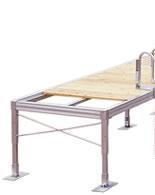
Sway Brace
Does every set of legs need sway braces?
No. PWS will make recommendations based on the heights and lengths of your dock or pier. Often, we add a single brace on a pair of legs. Next, we alternate the position in the opposite direction on the next set of legs.
One brace is attached near the bottom of one leg and clamped higher up on the opposite leg. This depends on the height of the legs.
It may involve a crew member having to submerge in the water to reach the bottom of the leg. In spring, that is not something anyone wants to do.
Does it matter if I have an aluminum or steel frame?
A steel frame is less likely to need braces than an aluminum frame due to its own weight. Different configurations are available for aluminum frames, but the principle is the same.
Braces are available for new installations, as shown here. There is an add-on version (independent components) for existing frames. They can be added to existing dock legs if needed. Either version will help stabilize your dock in deeper water.
Will sway braces help your dock?
Call Jerry at 920-493-4404 for more details.
Where is Pier & Waterfront Solutions?
Located at 7325 St. Hwy 57, it’s 3 miles south of Sturgeon Bay and 1 mile past the intersection of Cty MM (heading north). Look on the right side, one mile north, at the next corner (Idlewild Road and Hwy 57).
Is PWS OPEN?
Pier & Waterfront Solutions remains “open.” We have implemented measures to help ensure the safety of our employees and visitors. PWS continues to work to maintain the trusted service that you have come to expect.
PWS implemented these preventive measures:
1. Conducting as much business as possible by email, text, or phone.
2. Site visits will continue. When in-person contacts are necessary, we will follow “social distancing” guidelines.
3. Our display yard is always open for you to examine at your leisure. All displays have a numbered, red tag on them. If you want more information or pricing, please reference that number.
What can YOU do to help us?
1. Please conduct as much business as possible via emails, messaging, and emails. This step protects everyone involved.
2. When you see our crews installing equipment, please practice “social distancing.” Remain at a safe distance.
Thank you for allowing us to work with you.
YES – PWS is OPEN and waiting for you!
Please call, message, or email PWS with any questions.
Let’s all stay safe!
Aug 26, 2021
Dear Jerry,
You have 2 fantastic workers on your staff! Ben and Alex were so knowledgeable and hard working. We cannot be more impressed or pleased.
It just poured down rain on them for the whole time they were here! Your customers are in good hands with those two!
Cathi & Bob P.