Sep 7, 2021
SUMMER HAS ENDED
Summer for many people has ended. It’s a sad time for many people. People are heading home. Many families have to get back for school for the kids and can only come back on weekends. Still, there will be some great days left this Fall.
Many of our customers are from out of state. In fact, we have customers from almost ALL the United States. They return each year to enjoy some of our great Wisconsin weather. The size of the crowds will begin going down after Labor Day.
Have no FEAR! Spring is just a couple of months away!
But still, it’s a sad time for many people. Our Chicago and Minnesota customers are among the saddest at this time of the year. Why? They face another year of being defeated by the Packers.
Who else faces problems at this time of the year?
Another group is people with storm-damaged equipment. The Fall storms get stronger in September and October. That’s why we move as fast as we can to get to your location to safeguard your equipment by removing them for the year. The freezing water doesn’t help either.
If you have damage to your equipment please call Jerry @ 920-493-4404.
Not using your docks and lifts anymore this year?
It’s a good idea to drop Keri, our Service Manager, a line letting her know you are ready to be removed. Give her a date when your canopy will be down and your boat stored for the year. Email your message to Keri@wisconsinpws.com. She will put you on the schedule.
It’s particularly tough this year for our crews. One of the dealers in Door County closed expectantly before Memorial Day. Our teams will be working longer hours to adjust to the influx of new customers. As the days get shorter, they will be working by their headlights to meet the schedule.
Four things you should know about fall storms:
- PWS will assist you if a storm damages your equipment. We prepare Free estimates to cover your damage. Insurance companies then use the estimates to prepare a settlement for you.
- We recommend you read this article before talking to the insurance company. Take pictures of all the damage. The more images, the better.
- PWS can also salvage your equipment and make winter repairs, so you are ready to go in Spring.
- PWS will move your equipment to another location if you sold it or bought another property.
PROPERTY DAMAGE?
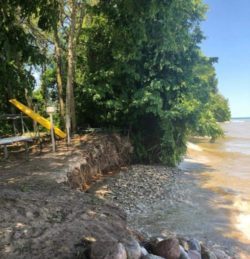
Shoreline Erosion
Do you have property damage, eroded beaches, and lawns? Don’t forget, Pier and Waterfront Solutions has a complete rip rap service available. We’ll have your shoreline repaired for Spring.
Call DAVE at 920-905-2588 for more details.
Where is Pier & Waterfront Solutions?
Located at 7325 St. Hwy 57, it’s 3 miles south of Sturgeon Bay and 1 mile past the intersection of Cty MM (heading north). Look on the right side, one mile north, at the next corner (Idlewild Road and Hwy 57).
Is PWS OPEN?
Pier & Waterfront Solutions remains “open.” We have implemented measures to help ensure the safety of our employees and visitors. PWS continues to work to maintain the trusted service that you have come to expect.
PWS implemented these preventive measures:
1. Conducting as much business as possible by email, text, or phone.
2. Site visits will continue. When in-person contacts are necessary, we will follow “social distancing” guidelines.
3. Our display yard is always open for you to examine at your leisure. All displays have a numbered, red tag on them. If you want more information or pricing, please reference that number.
What can YOU do to help us?
1. Please conduct as much business as possible via emails, messaging, and emails. This step protects everyone involved.
2. When you see our crews installing equipment, please practice “social distancing.” Remain at a safe distance.
Thank you for allowing us to work with you.
YES – PWS is OPEN and waiting for you!
Please call, message, or email PWS with any questions.
Let’s all stay safe!
Aug 31, 2021
DOCK SWAY BRACE
Is a sway brace used on your dock? If not, does your dock sway as you walk on it? There are several reasons this can happen to any dock or pier.
There are main TWO reasons for dock movement.
You need to distinguish between the two types of movement. Is it an up and down movement, or is it a side to side movement?
First, Let’s tackle the Up and Down movement.
When installed, PWS makes sure the legs are firmly on the bottom. This typically makes the dock stable for most people.
Yet, over time, storms can wash out or move the sand or rocks under the footpads. Sand is more susceptible to this action.
It’s the same effect that erosion has on the shoreline. First, it washes away sand and small stones from under the footpad. Then, it continues to work on the remaining stones and rocks. When enough materials are removed, there is nothing left to support the leg.
At this point, you may experience the sensation of up and down movement as you walk.
How do we prevent it from happening?
There is no way to completely prevent washing out of the footpads. If we disturb the lake bottom too much, it weakens the tightly packed base. Disturbing the lake bottom makes it easier for the wave action to wash the sand away. The sand (or small stones) are loosely packed and have small openings in them.
The only “cure” is to reset the legs firmly on the bottom. We notice this frequently occurs after strong storms. The “white caps” you see are moving the water under the surface also.
The second type of movement is actual “sway.”
“Sway” is the side-to-side movement when the dock is set higher above the water.
The current water level is still above average even though it is down from 2019 and 2020. This is evidenced by the continued erosion happening up and down the shoreline.
PWS raises your dock up to protect it from high wave action during the summer. When the frames are adjusted higher, the pier becomes less stable. Walking on the dock will cause a side-to-side movement because the center of gravity is higher.
Think of a simple fishing pole. When the pole moves at the bottom, the movement is amplified at the top of the pole. The higher the frames are raised, the more side movement will occur.
See this link for more information.
There is a solution.
A sway brace on the legs reduces the sway side sway. You’ll feel more secure as you walk the length of your dock.
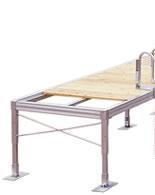
Sway Brace
Does every set of legs need sway braces?
No. PWS will make recommendations based on the heights and lengths of your dock or pier. Often, we add a single brace on a pair of legs. Next, we alternate the position in the opposite direction on the next set of legs.
One brace is attached near the bottom of one leg and clamped higher up on the opposite leg. This depends on the height of the legs.
It may involve a crew member having to submerge in the water to reach the bottom of the leg. In spring, that is not something anyone wants to do.
Does it matter if I have an aluminum or steel frame?
A steel frame is less likely to need braces than an aluminum frame due to its own weight. Different configurations are available for aluminum frames, but the principle is the same.
Braces are available for new installations, as shown here. There is an add-on version (independent components) for existing frames. They can be added to existing dock legs if needed. Either version will help stabilize your dock in deeper water.
Will sway braces help your dock?
Call Jerry at 920-493-4404 for more details.
Where is Pier & Waterfront Solutions?
Located at 7325 St. Hwy 57, it’s 3 miles south of Sturgeon Bay and 1 mile past the intersection of Cty MM (heading north). Look on the right side, one mile north, at the next corner (Idlewild Road and Hwy 57).
Is PWS OPEN?
Pier & Waterfront Solutions remains “open.” We have implemented measures to help ensure the safety of our employees and visitors. PWS continues to work to maintain the trusted service that you have come to expect.
PWS implemented these preventive measures:
1. Conducting as much business as possible by email, text, or phone.
2. Site visits will continue. When in-person contacts are necessary, we will follow “social distancing” guidelines.
3. Our display yard is always open for you to examine at your leisure. All displays have a numbered, red tag on them. If you want more information or pricing, please reference that number.
What can YOU do to help us?
1. Please conduct as much business as possible via emails, messaging, and emails. This step protects everyone involved.
2. When you see our crews installing equipment, please practice “social distancing.” Remain at a safe distance.
Thank you for allowing us to work with you.
YES – PWS is OPEN and waiting for you!
Please call, message, or email PWS with any questions.
Let’s all stay safe!
May 18, 2021
Weather Radar and Boaters
All Boaters need to understand weather radar.
In the old days, weather forecasters based their predictions on a combination of things:
2. Good eyesight (a weather eye); and
While today’s boater likely will look at his cell phone rather than looking up at the sky. For example, my wife can predict a change in weather by the pain in her elbow. She’s pretty accurate and she’s getting old too. (Note: I don’t let her read these.)
When dark clouds start building, having a basic understanding of how weather works can give you a head start on preparations.
Not all thunderstorms are intense, but they all are potentially dangerous. Boaters are especially vulnerable to the weather. They can’t simply run “inside” for protection. It pays to have basic weather-reading skills — so you can be prepared.
Here’s some help:
The Basics of Weather
Dark Clouds
Clouds
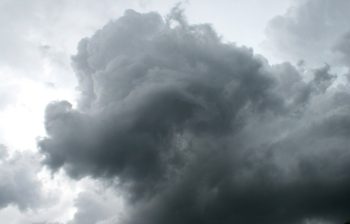
Whole books have been written on how to predict the weather by looking at clouds. Most people have a hard time remembering all the different types and what they signify. Here’s a simple rule of thumb: slow clouds get lower, or puffy clouds grow and get higher. Keep an eye out for rain or a storm. When looking at the sky, it’s helpful to remember that most weather changes come from the west. So keep your weather eye in that direction.
Generally, the slower the clouds change, the longer the duration of the weather change.
Thunderheads form quickly and dissipate just as quickly. Slowly thickening clouds associated with a cold front often mean a soaker.
Winds
Most of the time, winds are light in the morning. The winds pick up in the afternoon, and then return to light again as evening approaches.
If you find the wind speed not following the usual local pattern, suspect a change coming.
The direction of wind changes can also give you a heads-up to what’s coming. If the wind changes clockwise — say, from the south to southwest to the west — it usually means fair weather on the way.
If the wind changes counterclockwise, it usually signifies the approach of foul weather. An example would be, winds changing from the west to southwest and then to the south.
During the formation of a “pop-up” thunderstorm, the wind doesn’t always follow that rule. A “pop-up” thunderstorm often comes straight down from the clouds. It then spreads out in all directions. If you feel a sudden cool wind, check the sky for towering clouds.
Food for thought: When the speed of the wind increases, its effect on your boat rises exponentially. Your boat acts like a “sail.”
Did you know that a 20-knot wind has four times the force of a 10-knot wind?
Barometers
Weather Barometer
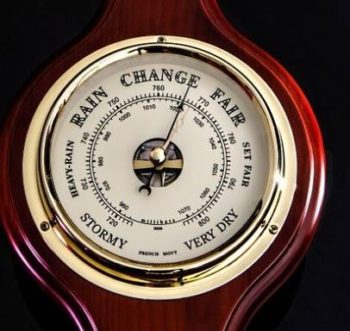
Barometers are more than just pretty brass instruments. The have a useful purpose. It’s just that most people do not understand their purpose – but they do look good.
Knowing what they’re saying can alert you to the advancing weather. Barometers are typically marked with areas of the face declaring “fair,” “changing,” and so on. The wording is misleading since reading a barometer is about noting changes.
A falling barometer usually means bad weather is approaching. It’s as much the speed of the change as the change itself that’s important to note.
A rapid fall means more significant changes. The normal pattern is a small up-and-down change that you can ignore.
A rapid rise may mean fair weather with strong winds. Typically, checking a barometer every couple of hours is adequate. Look for the direction of the change.
Thunder
If a thunderstorm is approaching, listening to thunder can tell you a lot about it. Counting the seconds between a “flash” of lightning and the “boom,” gives you the distance from the lightning. A five second difference equals about a mile.
Parents: if your children are afraid of thunder and lightning, explain that it is miles away. Then, distract them by asking them to count the seconds between the lightning and the thunder. It becomes a game for them, and they become less afraid of the noise.
Radar
Check the radar on your phone. Use the zip code 54301 for Green Bay. This is where the National Weather Service (NWS) is located. Their radar map includes the entire Door County peninsula.
The radar map will tell you where a storm is and where it’s heading. But, do not rely totally on radar. Because of the size of the Bay and Lake Michigan, there are frequently “pop-up” storms. That means unless you are actively looking at the radar, you can miss the approach of these storms.
Radar gives you the range and movement of the rain, allowing you to change course to avoid the worst. If the storm overtakes you – turn the boat “into” the waves and reduce speed.
Keep in mind, using the hourly radar will tell you where the rain is, but only a little information about the winds.
If you feel a sudden change in temperature, it signifies a change in wind intensity is coming. Start looking for a safe harbor, just in case.
Knowing the forecast before you head out is equally important.
BoatUS App
You can download and use the BoatUS App to track the weather. You’ll get small craft advisories and weather forecasts. Authorize “notifications” to receive updates about storm information. These occur each time NOAA tracks a storm heading your way.
NOAA
The most prominent weather data forecasts come from NOAA’s National Weather Service (NWS). NWS broadcasts weather for all parts of the U.S. via the Internet. It issues regular updated VHF broadcasts. All modern VHF radios can tune in to the forecasts, which operate on one of seven frequencies. Scan through the channels to find the best reception. Boaters can hear the computer-synthesized voice 25 miles or more from the transmitter.
The NOAA website lists current wind speed, wave height, and more at a nearby weather buoy. Go to: www.ndbc.noaa.gov for a look.
Weather Folk Lore
Red sky in morning, sailors take warning, red sky at night, sailors’ delight.
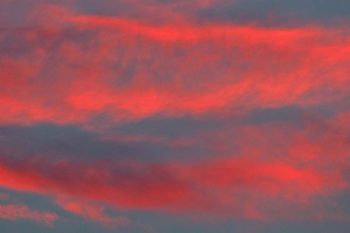
Pink Sky – Sailors Delight
Ever wonder what that means?
At night, a red sky signifies light passing through dust particles in the air in front of the setting sun. Dust indicates dry weather. Since most weather changes come from the west, a red sky at night means dry weather is approaching.
A red sky in the morning indicates that the dry air has moved east. Rain may be coming, especially if you see illuminated clouds.
If the morning sky is a deep fiery red, it means high water content in the atmosphere with the likelihood of rain. A gray sky at night means that the western air has a lot of moisture; therefore, it will likely rain soon.
One thing to remember: this rhyme can’t predict thunderstorms developing in the afternoon. Especially, when the morning has already been clear.
A summer fog for fair, a winter fog for rain.
Fog forms when the air cools enough that the water vapor condenses. When moist air moves over cold land, it will bring fog and possibly rain. For the air to be cool on a summer night, the sky must be clear. With clear skies, the excess heat can radiate into space. Cloudy skies act like a blanket, absorbing and re-radiating the heat, keeping it in.
If it is clear and cool enough for the fog to form on a summer morning, it should be clear later or at least by the next day.
When a halo rings the moon or sun, rain’s approaching on the run.
The halo around the sun or moon is caused by ice crystals high in the sky. A warm front is approaching and usually rain will be here within 24 hours. The rhyme is more accurate in the summer than the winter.
The higher the clouds, the better the weather.
High clouds mean both dry air and high atmospheric pressure. These indicate fair weather. Lower clouds mean approaching rain.
Marine Warnings and What They Mean
- Gale Warning: This is published when winds will be in the range of 34 to 47 knots.
- Storm Warning: This is issued if winds between 48 to 63 knots are forecast.
-
Special Marine Warning: This warning is for boaters, in particular. It is issued whenever a severe local storm or strong wind of brief duration is imminent. It is not covered by existing warnings or advisories.
To sum this up – Learn all you can about clouds and winds – It can mean the difference between a nice cruise and a disaster.
Where can I find Pier & Waterfront Solutions?
Pier & Waterfront Solutions, 7325 St. Hwy 57, is located 3 miles south of Sturgeon Bay. Go 1 mile PAST the intersection with County MM (heading north). Look on the right at the intersection of Idlewild Road and Hwy 57.
PWS is

Pier & Waterfront Solutions remains “open” year-round.
The Covid-19 virus is beginning to wane. We can only hope people will continue to get the vaccine to help slow this illness. We continue to conduct as much business as possible by email, text, or phone.
Site visits continue as usual. When making in-person contacts, we follow “social distancing” guidelines when possible.
PWS display yard – OPEN 24-7
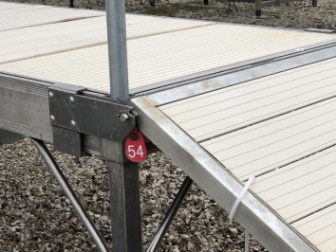
Red Tag
PWS‘s display area is always open for you to examine at your leisure. All displays available for sale have a numbered, red tag on them. Want more information on something you saw in our yard? Please reference that number when you inquire.
PWS provides estimates by email to make the process faster, safer, and paperless.
Call, message, or email Jerry with any questions.

Jerry Englebert
Contact Jerry at 920-493-4404 for more information or use this link.
Apr 6, 2021
The best dock selection in Door County
Pier & Waterfront Solutions customers have access to the best dock selection, more dock styles and more materials than any other Door County dealer.
Most dealers offer only aluminum docks or a few lightweight steel dock. Some even offer one or two brands.
Aluminum is popular because it is lightweight and easier to handle.
Who has the best aluminum dock in Door County?
Pier & waterfront Solutions offers (6) ShoreMaster aluminum constructions – in roll-in, stationary, and floating docks.
Now that’s a some dock selection!
Here is a comparison of the aluminum constructions offered:
RS 4 –
4″ side rails. 10′ sections, seven types of decking, aluminum or steel legs. Ideal for calm waters on an inland lake or sheltered area.
RS 4 Curved –
The RS4 Curved dock sections are built the same as the same rigorous specs as the RS 4 shown above. Why is this different? The availability of 45- degree and 90-degree curved sections. These curved sections allow for many configurations that no one else offers. (Hint – You can use curved sections with the ANY ShoreMaster dock frame to genuinely make your dock unique.
RS7*
7″ side rails. 8′ and 16′ sections, with seven types of decking, aluminum or steel legs. Ideal for the rough waters in an open area.
TS9*
9″ Truss side frames. 8′ and 16′ sections, seven types of decking, aluminum or steel legs. Ideal for the rough waters in most open areas.
FTS9 –
The FTS9 has the identical construction of the TS9 in all respects. The frames have floats attached and are ideal for soft muddy bottoms.
Poly Dock –
Poly Dock is a modular dock design made of rotationally molded polyethylene. There are NO unsightly black floats used.
It’s a floating dock system that can withstand up to 2′ waves, making it ideal for inland lakes or rivers with muddy bottoms and large water fluctuations.
Over the years, PWS provided hundreds of ShoreMaster aluminum docks, but it is not always the best solution for all shorelines.
What other dock selection is available?
With the high water and intense storms we have experienced in recent years, PWS now offers the exclusive
3-Season Pier
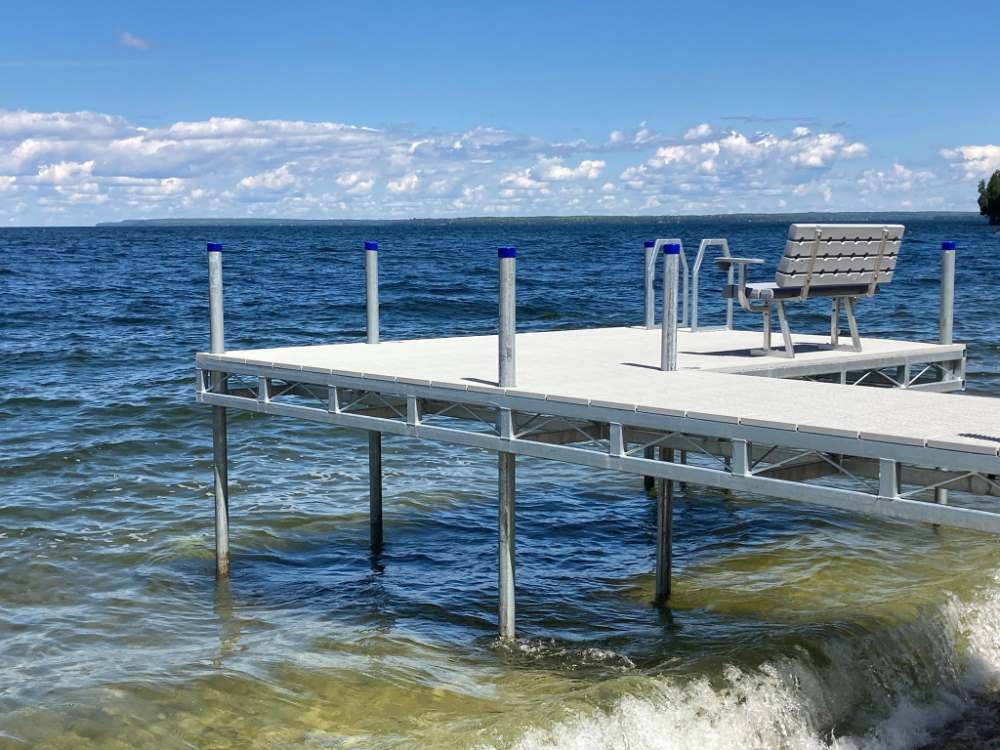
3-Season Pier
The 3-Season steel pier is built to demanding specifications for strength and durability.
3-Season piers have withstood just about everything Mother Nature can throw at it. No Wisconsin manufacturer builds a heavier frame section. It weighs over a quarter ton without the oversized steel legs.
PWS recommends flow-through decking for the 3-Season pier. Flow-through decking relieves any upward pressure caused by a storm’s high waves.
PWS installs everything we sell.
Now you know why Pier & Waterfront Solutions is so popular.
We offer everything you need for your dock or lift. Contact us TODAY!
Where can I find Pier & Waterfront Solutions?
Pier & Waterfront Solutions, 7325 St. Hwy 57, is located 3 miles south of Sturgeon Bay. Go 1 mile PAST the intersection with County MM (heading north). Look on the right at the next corner – Idlewild Road and Hwy 57.
Pier & Waterfront Solutions remains “open” year-round.
The Covid-19 virus continues to spread and affects many people. We are conducting as much business as possible by email, text, or phone.
Site visits continue as usual. When making in-person contacts, we follow “social distancing” guidelines when possible.
PWS display yard – OPEN 24-7
Red Tag
PWS‘s display area is always open for you to examine at your leisure. All displays available for sale have a numbered, red tag on them. Want more information on something you saw in our yard? Please reference that number when you inquire.
PWS provides estimates by email to make the process faster, safer, and paperless.
Call, message, or email Jerry with any questions.
Jerry Englebert
Contact Jerry at 920-493-4404 for more information or use this link.
* Combine the RS4 Curved sections with this frame for a unique design.
Mar 23, 2021
A NEW Barge Announcement at PWS
Before we get into the new barge discussion, it seems like a long winter despite it being a mild winter. The virus only added to the winter confinement & misery.
The early disappearance of the ice on Green Bay has lifted our spirits. Everyone has hopes for the approaching Spring.
Yet, nature has a way of thwarting or at least delaying those plans. There is snow again in the forecast for this week. Snow is nature’s way of saying she is still in control and not yet willing to give it up.
Phone Install Requests
For the last few weeks, we had requests for projected install dates. Please be patient. We know from many years of experience that there are snowstorms in our future. Remember, the ice is still on the shorelines. The lack of snow gives the impression the season could start as soon as this week.
In reality, the expected start date is “around” April 1. About two years ago, the season got underway early. After a week of installs, a huge snowstorm put a complete stop to the work for two more weeks. It was a struggle to get all the work done.
What have we done to keep up with installs?
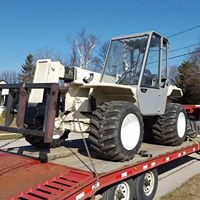
All-Terrain Forklift
What have we done to keep up with the installs? We have added two more ATF’s (All-Terrain Forklift) to our fleet of equipment. The latest addition brings our total to FIVE ATF’s.
Latest Barge addition at PWS
Today, we are announcing the latest addition to Pier & Waterfront Solutions equipment list.
As many of you know, PWS has a large 24′ x 45′ barge used for rip-rap installations. The barge and excavators are also used for dock and lift installs in areas where our ATF’s cannot go. When the need arises, we use the barge and one of our excavators to install docks and lifts. These are challenging areas to access and operate any equipment.
If you’ve driven past our location in the past month or so, you may have seen this.
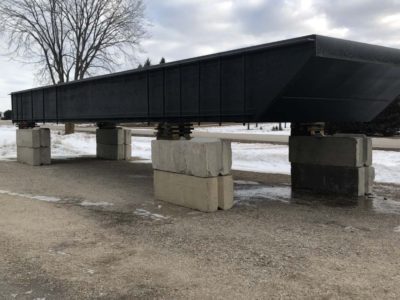
Barge
The new barge addition will allow us to expand our existing barge size by another 12′ x 45′. When joined with the existing barge, the new barge will be 36′ x 45′. (1,620 sq. ft. – That’s the size of a small house). That gives us increased load capacity to transport more equipment and materials. It will save time and allow us to be more efficient in the future.
The new barge can separated from the original barge for independent use at a later date if needed.
PWS have two experienced barge operators to move this equipment between locations.
Where is Pier & Waterfront Solutions?
Pier & Waterfront Solutions, 7325 St. Hwy 57, is located 3 miles south of Sturgeon Bay. Go 1 mile PAST the intersection with County road MM (heading north). Look on the right at the next corner – Idlewild Road and Hwy 57.
Is PWS OPEN?
Pier & Waterfront Solutions remains “open” year-round.
The Covid virus continues to spread and affects many people. Don’t be one of them.
PWS is conducting as much business as possible by email, text, or phone.
Site visits continue as usual. When making in-person contacts, we follow “social distancing” guidelines when possible.
PWS display yard – OPEN 24-7
Red Tag
PWS‘s display area is always open for you to examine at your leisure. All displays available for sale have a numbered, red tag on them. Want more information on something you saw in our yard? Please reference that number when you inquire.
PWS will provide estimates by email to make the process faster, safer, and paperless.
Call, message, or email us today with any questions.
Call Jerry at 920-493-4404 for more information or use this link.