Aug 31, 2021
DOCK SWAY BRACE
Is a sway brace used on your dock? If not, does your dock sway as you walk on it? There are several reasons this can happen to any dock or pier.
There are main TWO reasons for dock movement.
You need to distinguish between the two types of movement. Is it an up and down movement, or is it a side to side movement?
First, Let’s tackle the Up and Down movement.
When installed, PWS makes sure the legs are firmly on the bottom. This typically makes the dock stable for most people.
Yet, over time, storms can wash out or move the sand or rocks under the footpads. Sand is more susceptible to this action.
It’s the same effect that erosion has on the shoreline. First, it washes away sand and small stones from under the footpad. Then, it continues to work on the remaining stones and rocks. When enough materials are removed, there is nothing left to support the leg.
At this point, you may experience the sensation of up and down movement as you walk.
How do we prevent it from happening?
There is no way to completely prevent washing out of the footpads. If we disturb the lake bottom too much, it weakens the tightly packed base. Disturbing the lake bottom makes it easier for the wave action to wash the sand away. The sand (or small stones) are loosely packed and have small openings in them.
The only “cure” is to reset the legs firmly on the bottom. We notice this frequently occurs after strong storms. The “white caps” you see are moving the water under the surface also.
The second type of movement is actual “sway.”
“Sway” is the side-to-side movement when the dock is set higher above the water.
The current water level is still above average even though it is down from 2019 and 2020. This is evidenced by the continued erosion happening up and down the shoreline.
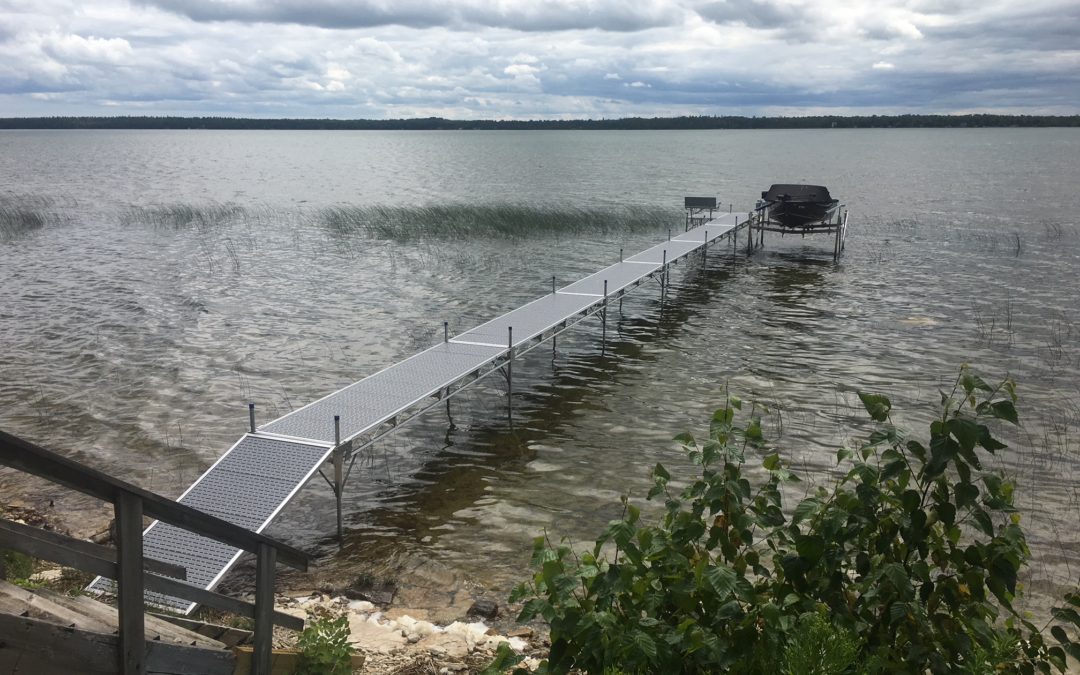
PWS raises your dock up to protect it from high wave action during the summer. When the frames are adjusted higher, the pier becomes less stable. Walking on the dock will cause a side-to-side movement because the center of gravity is higher.
Think of a simple fishing pole. When the pole moves at the bottom, the movement is amplified at the top of the pole. The higher the frames are raised, the more side movement will occur.
See this link for more information.
There is a solution.
A sway brace on the legs reduces the sway side sway. You’ll feel more secure as you walk the length of your dock.
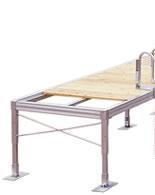
Sway Brace
Does every set of legs need sway braces?
No. PWS will make recommendations based on the heights and lengths of your dock or pier. Often, we add a single brace on a pair of legs. Next, we alternate the position in the opposite direction on the next set of legs.
One brace is attached near the bottom of one leg and clamped higher up on the opposite leg. This depends on the height of the legs.
It may involve a crew member having to submerge in the water to reach the bottom of the leg. In spring, that is not something anyone wants to do.
Does it matter if I have an aluminum or steel frame?
A steel frame is less likely to need braces than an aluminum frame due to its own weight. Different configurations are available for aluminum frames, but the principle is the same.
Braces are available for new installations, as shown here. There is an add-on version (independent components) for existing frames. They can be added to existing dock legs if needed. Either version will help stabilize your dock in deeper water.
Will sway braces help your dock?
Call Jerry at 920-493-4404 for more details.
Where is Pier & Waterfront Solutions?
Located at 7325 St. Hwy 57, it’s 3 miles south of Sturgeon Bay and 1 mile past the intersection of Cty MM (heading north). Look on the right side, one mile north, at the next corner (Idlewild Road and Hwy 57).
Is PWS OPEN?
Pier & Waterfront Solutions remains “open.” We have implemented measures to help ensure the safety of our employees and visitors. PWS continues to work to maintain the trusted service that you have come to expect.
PWS implemented these preventive measures:
1. Conducting as much business as possible by email, text, or phone.
2. Site visits will continue. When in-person contacts are necessary, we will follow “social distancing” guidelines.
3. Our display yard is always open for you to examine at your leisure. All displays have a numbered, red tag on them. If you want more information or pricing, please reference that number.
What can YOU do to help us?
1. Please conduct as much business as possible via emails, messaging, and emails. This step protects everyone involved.
2. When you see our crews installing equipment, please practice “social distancing.” Remain at a safe distance.
Thank you for allowing us to work with you.
YES – PWS is OPEN and waiting for you!
Please call, message, or email PWS with any questions.
Let’s all stay safe!
Jul 6, 2021
Today we have a request for YOUR assistance.
As you may know, we have written several articles about the Glacier Flow Thru and Sun Walk decking used on the ShoreMaster docks and PWS‘s own 3-Season Pier, respectively. (We use two deck brands due to the different widths of the docks.)
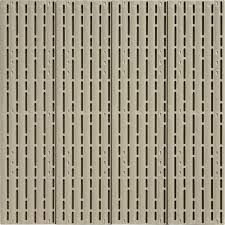
Open Decking by ShoreMaster
Each time we write an article about decking, we try to write a better description of what open decking is all about.
Like the old saying goes-
“A picture is worth a thousand words,
But a video is worth a whole lot more.”
(OK, we expanded on that old saying)
We can’t predict when and where the next big storm will hit. When and where will the waves be breaking through the decking? What does it look like when the wave is so high it actually tries to lift the decking (and the dock if you have planks instead of open decking) but ends up being dispersed as it goes through the decking instead?
Why does the 3-Season Pier stands up so well to storms? We can try to describe it in words all day long but a photo or video is much more effective.
An actual demonstration of open decking doing it’s thing is important to new customers and people considering re-decking their existing dock. They want proof that their dock stands a much better chance of weathering the storm?
Have you taken photos or videos of a dock in a storm?
During a severe storm, many people take photos or videos to show friends and neighbors what happened. Maybe you saw a dock floating into a boat lift or waves crashing through the decking. Perhaps a loose boat hit a dock, and you got the video.
We want to publish those pictures and videos. If you have these or are willing to take photos or videos (safely, of course), we ask you to email them to us. Time permitting – we’ll try to email the article to you before it’s published.
Email them to: mike@wisconsinpws.com
In the past, we received and used a great video of the wave itself being destroyed by rip-rap placed on the shoreline. The waves actually melt away harmlessly. The real demonstration starts at :30 seconds.
We want your images of a storm trying to destroy a dock.
We prefer no audio at all.
If you want credit for the videos or pictures, just let us know. With your permission, we will include your first name and the first letter of your last name, along with a general location like this – “credits: John B., Sister Bay.” We’ll post them on YouTube also. Be the first to get published. Our readers include countries other than the U.S.
Finally – a THANK YOU!!
We would like to acknowledge the notes and testimonials we have received over the years. Our crews work hard to do the job right the first time. They sometimes fail, but we always take care of our customers if it happens. We always bring your notes to their attention when you mention their name.
We post these notes in the “Customer Testimonial“ section – word for word, as written – on our website.
Tell Your Friends & Family
Have friends or neighbors you believe should see this article? Email them this link – and Thank you!
Visit Pier & Waterfront Solutions on Facebook.
Don’t Forget – Considering rip-rap for your shoreline? PWS is the place to contact!
Where is Pier & Waterfront Solutions?
Located at 7325 St. Hwy 57, it’s 3 miles south of Sturgeon Bay and 1 mile past the intersection of Cty MM (heading north). Look on the right side, one mile north, at the next corner (Idlewild Road and Hwy 57).
Is PWS OPEN?
Pier & Waterfront Solutions has remained “open.” We have implemented measures to ensure the safety of our employees and visitors. At the same time, we are working to maintain the trusted service that you have come to expect.
PWS implemented these precautionary measures:
1. Conducting as much business as possible by email, text, or phone.
2. Site visits will continue. When in-person contacts are necessary, we will follow “social distancing” guidelines.
3. Our display yard is always open for you to examine at your leisure. All displays have a numbered, red tag on them. If you want more information or pricing, please reference that number.
What can YOU do to help us?
1. Please conduct as much business as possible via emails, messaging, and emails. This step protects everyone involved.
2. When you see our crews installing equipment, please practice “social distancing.”
Thank you for allowing us to work with you.
So – YES – PWS is OPEN and waiting for you?
Please call, message, or email PWS with any questions.
Let’s all stay safe!
May 28, 2020
Is Your Pier Missing a Dock Storage Box?
Is a Dock Storage Box on your summer shopping list? How many times do you walk to your pier, only to kick yourself because you wish you had a storage box? Do you always forget something? Every time you set foot on your dock, do you think of all the equipment you could store in it? Where do you store the life preservers? Wouldn’t a dock storage box be convenient?
What Makes A Great Storage Box?
Unsure of what to look for in a storage or dock box? Are you afraid to purchase one because you don’t know enough about them? Read on to find helpful info about storage boxes. They will make life much easier for you.
Does the Storage Box Have Tight Fits?
Water Laser Cutting Technology, used on the best dock storage boxes, ensures the best fit. This process offers a consistent, precision cut for all the various pieces. This precision makes for a superior fit. Precision cuts and quality hinges fit together better. The box is less likely to suffer from leaks or damage.
Additionally, these dock storage boxes constructed from fiberglass provide a far superior product.
What’s The Alternative?
The alternative, polyethylene (plastic) storage boxes, fade, discolor, and warp in sunlight. As a result, this depreciates its usage and aesthetic value.
Fiberglass dock storage boxes also come with a gel-coat finish to add an extra layer of protection. Like polyethylene dock boxes, the gel-coat finish will oxidize in sunlight. So what’s the difference then? The difference is, you can buff and wax the oxidation off of the box to keep it looking brand new, year after year.
Buffing and waxing increase the durability of the box in the form of scrape and cut resistance. You can buff and wax any imperfections with a rubbing compound and watch them disappear. The process is like cleaning the hull of a boat on a smaller scale.
Do Polyethlene Dock Storage Boxes Have Gel-Coating?
Polyethylene dock storage boxes do not have a gel-coat finish. Once the sun damages the plastic material, it’s impossible to restore the surface to a like-new finish again.
The failure of the polyethylene storage boxes to withstand the sun will cause you to consider buying a new dock box. This type of failure will happen much sooner with a Polyethylene box than if you had chosen a fiberglass dock box initially.
Choose quality first to save time and money.
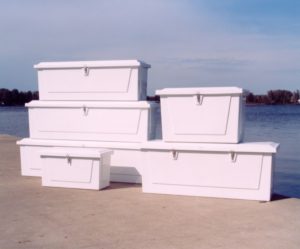
Assorted Dock storage Box sizes
Dock storage boxes come in many sizes including:
98″ x 22″ x 24.5″ H 85″ x 22″ x 24.5″
72″ x 26.5″ x 27.5″ 74″ x 38″ x 36″
71″ x 22″ x 24.5″ 33″ x 24″ x 18″
44.5″ x 26.5″ x 27.5″ 39.5″ x 19.75″ x 21.5″
Triangular and Low profile versions are also avaiable. Call for more information.
Not enough room to mount a dock box on your dock?
PWS has alternatives including, side mounts, for the boxes.
NEW – this year!
This year PWS has another alternative that was not available in the past. Talk to Jerry about trading your dock for the new 3-Season Pier, which we are now offering.
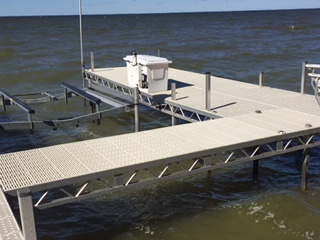
This new steel dock can handle storms better due to it’s higher weight and the “open” decking we use. Combining these two features makes it the heaviest pier on Green Bay. It has survived installations on Lake Michigan also.
An additional feature is the 4′ x 10′ “L,” which is standard on the 3-Season dock. This allows 16 sq feet more than lesser docks. It makes it easier to mount a dock box, enter a boat lift, and entertain your friends.
Tell Your Friends & Family
Have friends or neighbors you believe should see this article? Email them this link – and Thank you!
Don’t Forget – Considering rip-rap for your shoreline? PWS is the place to contact!
Where is Pier & Waterfront Solutions?
Located at 7325 St. Hwy 57, it’s 3 miles south of Sturgeon Bay, and 1 mile past the intersection of Cty MM (heading north). Look on the right side, one mile north, at the next intersection (Idlewild Road and Hwy 57).
ARE WE OPEN?
During this time of uncertainty, Pier & Waterfront Solutions is staying “open.” We have implemented measures to ensure the safety of our employees and visitors. At the same time, we are working to maintain the trusted service that you have come to expect.
We are implementing these precautionary measures:
1. Conducting as much business as possible by email, text, or phone.
2. Site visits will continue but with limited in-person meetings. When in-person contacts are necessary, we will follow “social distancing” guidelines.
3. Our display yard is always open for you to examine at your leisure. All displays have a numbered, red tag on them. If you want more information or pricing, please reference that number.
Is there More?
4. Some employees will be working remotely, but they are always available by phone.
5. Any employee with symptoms or illness is sent home.
6. We continue to provide estimates and invoices by email to make the process paperless.
7. Crew starting times are being staggered to limit social interactions.
8. We keep the same crews together to limit cross interactions.
With these measures, we hope everyone will stay safe, and we will be back to normal operations soon.
What can you do to help us?
1. Please conduct as much business as possible via emails, messaging, and emails. This step protects everyone involved.
2. When you see our crews installing equipment, please practice “social distancing.”
Thank you for allowing us to work with you.
So – YES – ARE WE OPEN?
Please call, message, or email us with any questions.
Let’s all stay safe!
Contact:
Jerry @ (920) 493-4404 or Jerry@wisconsinpws.com – Commercial work & new/used Sales.
Dave @ (920) 905-2588 or Dave@wisconsinpws.com – Erosion control & shoreline work.
Jerry @ (920) 493-4404 or Jerry@wisconsinpws.com – Scheduling & Service work
May 26, 2020
10 Best Boat Docking tips
Docking a boat or putting it into a boat lift is not the favorite activity for any boater. Until you feel confident about what you are doing, it can be down-right terrifying. It was so easy to go out. – why can’t it be just as simple to come back in?
Follow the best boat docking tips shown here and it will make it easier for any boater.
- Always put safety first. Check the surrounding area before approaching a dock. Kids love to swim under the dock to greet you.
- VERY IMPORTANT – How fast are you going? Are the waves pushing you too fast? Are you willing to hit the dock or boat lift at that speed?
- Remember – Slow speeds will always give you more time to correct your course. Slower speeds also cause less damage. On the flip side, it is harder to control the boat at slower speeds.
Follow the next steps for greater control:
- Always turn the wheel BEFORE applying any power – not during or after. This is very important for a single-engine boat.
Note – Twin inboards? Keep your hands off the wheel with twin inboards. If you do turn the wheel, the boat may take an unexpected path when you try to use the engines.
- Apply short bursts instead of steady power to the engine. You won’t build up a lot of momentum, and you will have better control of the boat. Speed and momentum are the opposite of control.
- Always stay under power. Without power, you can not control the direction of the boat. Keep the engine on so you can maneuver as necessary.
- Secure all ropes and make sure they are not wrapped around anyone’s hands or feet.
- Always communicate with passengers as you approach the dock. Managing your crew or guests before and during docking is important to make docking safer.
- Always reduce your windage in heavy winds. Particularly in a small boat.
- Don’t worry about stopping and doing it over again. If you see a problem, it’s better to reverse the motor than hit something. On your next pass, it may be better – come back for another try.
Tell Your Friends & Family
Have friends or neighbors you believe should see this article? Email them this link – and Thank you!
Where is Pier & Waterfront Solutions?
Located at 7325 St. Hwy 57, it’s 3 miles south of Sturgeon Bay, and 1 mile past the intersection of Cty MM (heading north). Look on the right side, one mile north at the next intersection (Idlewild Road and Hwy 57).
We look forward to talking to you.
ARE WE OPEN?
During this time of uncertainty, Pier & Waterfront Solutions is staying “open.” We have implemented measures to ensure the safety of our employees and visitors. At the same time, we are working to maintain the trusted service that you have come to expect.
We are implementing these precautionary measures:
1. Conducting as much business as possible by email, text, or phone.
2. Site visits will continue but with limited in-person meetings. When in-person contacts are necessary, we will follow “social distancing” guidelines.
3. Our display yard is always open for you to examine at your leisure. All displays have a numbered, red tag on them. If you want more information or pricing, please reference that number.
Is there More?
4. Some employees will be working remotely, but they are always available by phone.
5. Any employee with symptoms or illness is sent home.
6. We continue to provide estimates and invoices by email to make the process paperless.
7. Crew starting times are being staggered to limit social interactions.
8. We keep the same crews together to limit cross interactions.
With these measures, we hope everyone will stay safe, and we will be back to normal operations soon.
What can you do to help us?
1. Please conduct as much business as possible via emails, messaging, and emails. This step protects everyone involved.
2. When you see our crews installing equipment, please practice “social distancing.”
Thank you for allowing us to work with you.
So – YES – ARE WE OPEN?
Please call, message, or email us with any questions.
Let’s all stay safe!
Contact:
Jerry @ (920) 493-4404 or Jerry@wisconsinpws.com – Commercial work & new/used Sales.
Dave @ (920) 905-2588 or Dave@wisconsinpws.com – Erosion control & shoreline work.
Jerry @ (920) 493-4404 or Jerry@wisconsinpws.com – Scheduling & Service work
Apr 28, 2020
3 REASONS FOR A SHORTER DOCK
The high water again this year means that your dock and boat lift will once again be taking a beating. (see article)
Last year, some people insisted on putting their entire dock in. Additionally, they wanted their boat lifts at the end of the dock. We advised against this, and we will be asking again this year. Why do we recommend this?
THE LEGAL REASON
First, the Legal reason – the DNR restricts a dock from being in water depths deeper than necessary to float a boat. In the past, in some areas, this meant a dock could be 200′ long (with warning lights to alert boaters in the dark).
Even that 200′ dock was legal as long as it did not obstruct boat traffic. If the water levels were shallow, you had to go that far out to launch a boat in some areas.
Today, that same dock could be closer to 100′ (or less) due to the extremely high water.
NOW – THE PRACTICAL REASON
Second, the reason for a shorter dock this year is simple – The water is EVEN HIGHER this year. There is a better chance that your dock and boat will survive the storms.
NEXT, THE FINANCIAL REASON
Finally, do you want to save money as well as reduce the risk of damage to your dock & boat lifts? The cost of installation depends, among other things, on the actual time it takes to install your equipment. Often, fewer sections equate to lower costs.
What’s the alternative to a shorter dock?
Without your agreement, we had to install the full length. If you didn’t agree, we felt we had no choice but to replace the legs with longer legs. We had to do this to compensate for the higher water. But, this route results in higher costs for installation.
Some homeowners took us up on the shorter docks in the hope that the water would go down in 2020. It didn’t! Others opted for lengthening the legs.
From our standpoint, it requires more time to replace the legs with longer ones than to shorten the dock.
So – What Happened?
Some docks did not have longer legs put on, and we installed the entire length. Still, they survived. If this was your dock, feel fortunate.
For those who did NOT allow us to do one of these alternatives, we will be asking you to choose again this year. Remember, the water is even higher this year.
We would prefer to leave one or two sections uninstalled this year. The alternative, we will request that you allow us to put longer legs on your dock. Our goal is simple – we want to limit damage to your dock.
Also remember, with longer legs, your dock may have more “sway” to it. If that happens, we recommend sway braces.
Even with longer legs, we will ask you to move your boat, and jet ski lifts closer to the shore. This will help protect them from the waves. The lifts have limited leg lengths (without getting longer legs). Your boat could pay the price if we don’t use one of these alternatives.
NEW – this year!
This year PWS has another alternative that was not available in the past. Talk to Jerry about trading your dock for the new 3-Season Pier, which we are now offering.
This new steel dock can handle storms better due to it’s greater weight and the “open” decking we use. Combining these two features makes it the heaviest pier on Green Bay. It has survived installations on Lake Michigan also.
Tell Your Friends & Family
Have friends or neighbors you believe should see this article? Email them this link – and Thank you!
Don’t Forget – Considering rip-rap for your shoreline? PWS is the place to contact!
PWS is open for business as usual. Practicing “Social Distancing”? We do business by phone and emails also.
Where is Pier & Waterfront Solutions?
Located at 7325 St. Hwy 57, it’s 3 miles south of Sturgeon Bay, and 1 mile past the intersection of Cty MM (heading north). Look on the right side, one mile north, at the next intersection (Idlewild Road and Hwy 57).
ARE WE OPEN?
During this time of uncertainty, Pier & Waterfront Solutions is staying “open.” We have implemented measures to ensure the safety of our employees and visitors. At the same time, we are working to maintain the trusted service that you have come to expect.
We are implementing these precautionary measures:
1. Conducting as much business as possible by email, text, or phone.
2. Site visits will continue but with limited in-person meetings. When in-person contacts are necessary, we will follow “social distancing” guidelines.
3. Our display yard is always open for you to examine at your leisure. All displays have a numbered, red tag on them. If you want more information or pricing, please reference that number.
Is there More?
4. Some employees will be working remotely, but they are always available by phone.
5. Any employee with symptoms or illness is sent home.
6. We continue to provide estimates and invoices by email to make the process paperless.
7. Crew starting times are being staggered to limit social interactions.
8. We keep the same crews together to limit cross interactions.
With these measures, we hope everyone will stay safe, and we will be back to normal operations soon.
What can you do to help us?
1. Please conduct as much business as possible via emails, messaging, and emails. This step protects everyone involved.
2. When you see our crews installing equipment, please practice “social distancing.”
Thank you for allowing us to work with you.
So – YES – ARE WE OPEN?
Please call, message, or email us with any questions.
Let’s all stay safe!
Contact:
Jerry @ (920) 493-4404 or Jerry@wisconsinpws.com – Commercial work & new/used Sales.
Dave @ (920) 905-2588 or Dave@wisconsinpws.com – Erosion control & shoreline work.
John @ (920) 493-4405 or John@wisconsinpws.com – Scheduling & Service work