Sep 7, 2021
SUMMER HAS ENDED
Summer for many people has ended. It’s a sad time for many people. People are heading home. Many families have to get back for school for the kids and can only come back on weekends. Still, there will be some great days left this Fall.
Many of our customers are from out of state. In fact, we have customers from almost ALL the United States. They return each year to enjoy some of our great Wisconsin weather. The size of the crowds will begin going down after Labor Day.
Have no FEAR! Spring is just a couple of months away!
But still, it’s a sad time for many people. Our Chicago and Minnesota customers are among the saddest at this time of the year. Why? They face another year of being defeated by the Packers.
Who else faces problems at this time of the year?
Another group is people with storm-damaged equipment. The Fall storms get stronger in September and October. That’s why we move as fast as we can to get to your location to safeguard your equipment by removing them for the year. The freezing water doesn’t help either.
If you have damage to your equipment please call Jerry @ 920-493-4404.
Not using your docks and lifts anymore this year?
It’s a good idea to drop Keri, our Service Manager, a line letting her know you are ready to be removed. Give her a date when your canopy will be down and your boat stored for the year. Email your message to Keri@wisconsinpws.com. She will put you on the schedule.
It’s particularly tough this year for our crews. One of the dealers in Door County closed expectantly before Memorial Day. Our teams will be working longer hours to adjust to the influx of new customers. As the days get shorter, they will be working by their headlights to meet the schedule.
Four things you should know about fall storms:
- PWS will assist you if a storm damages your equipment. We prepare Free estimates to cover your damage. Insurance companies then use the estimates to prepare a settlement for you.
- We recommend you read this article before talking to the insurance company. Take pictures of all the damage. The more images, the better.
- PWS can also salvage your equipment and make winter repairs, so you are ready to go in Spring.
- PWS will move your equipment to another location if you sold it or bought another property.
PROPERTY DAMAGE?
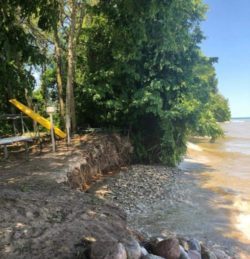
Shoreline Erosion
Do you have property damage, eroded beaches, and lawns? Don’t forget, Pier and Waterfront Solutions has a complete rip rap service available. We’ll have your shoreline repaired for Spring.
Call DAVE at 920-905-2588 for more details.
Where is Pier & Waterfront Solutions?
Located at 7325 St. Hwy 57, it’s 3 miles south of Sturgeon Bay and 1 mile past the intersection of Cty MM (heading north). Look on the right side, one mile north, at the next corner (Idlewild Road and Hwy 57).
Is PWS OPEN?
Pier & Waterfront Solutions remains “open.” We have implemented measures to help ensure the safety of our employees and visitors. PWS continues to work to maintain the trusted service that you have come to expect.
PWS implemented these preventive measures:
1. Conducting as much business as possible by email, text, or phone.
2. Site visits will continue. When in-person contacts are necessary, we will follow “social distancing” guidelines.
3. Our display yard is always open for you to examine at your leisure. All displays have a numbered, red tag on them. If you want more information or pricing, please reference that number.
What can YOU do to help us?
1. Please conduct as much business as possible via emails, messaging, and emails. This step protects everyone involved.
2. When you see our crews installing equipment, please practice “social distancing.” Remain at a safe distance.
Thank you for allowing us to work with you.
YES – PWS is OPEN and waiting for you!
Please call, message, or email PWS with any questions.
Let’s all stay safe!
Aug 31, 2021
DOCK SWAY BRACE
Is a sway brace used on your dock? If not, does your dock sway as you walk on it? There are several reasons this can happen to any dock or pier.
There are main TWO reasons for dock movement.
You need to distinguish between the two types of movement. Is it an up and down movement, or is it a side to side movement?
First, Let’s tackle the Up and Down movement.
When installed, PWS makes sure the legs are firmly on the bottom. This typically makes the dock stable for most people.
Yet, over time, storms can wash out or move the sand or rocks under the footpads. Sand is more susceptible to this action.
It’s the same effect that erosion has on the shoreline. First, it washes away sand and small stones from under the footpad. Then, it continues to work on the remaining stones and rocks. When enough materials are removed, there is nothing left to support the leg.
At this point, you may experience the sensation of up and down movement as you walk.
How do we prevent it from happening?
There is no way to completely prevent washing out of the footpads. If we disturb the lake bottom too much, it weakens the tightly packed base. Disturbing the lake bottom makes it easier for the wave action to wash the sand away. The sand (or small stones) are loosely packed and have small openings in them.
The only “cure” is to reset the legs firmly on the bottom. We notice this frequently occurs after strong storms. The “white caps” you see are moving the water under the surface also.
The second type of movement is actual “sway.”
“Sway” is the side-to-side movement when the dock is set higher above the water.
The current water level is still above average even though it is down from 2019 and 2020. This is evidenced by the continued erosion happening up and down the shoreline.
PWS raises your dock up to protect it from high wave action during the summer. When the frames are adjusted higher, the pier becomes less stable. Walking on the dock will cause a side-to-side movement because the center of gravity is higher.
Think of a simple fishing pole. When the pole moves at the bottom, the movement is amplified at the top of the pole. The higher the frames are raised, the more side movement will occur.
See this link for more information.
There is a solution.
A sway brace on the legs reduces the sway side sway. You’ll feel more secure as you walk the length of your dock.
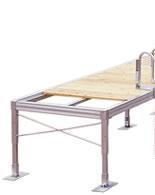
Sway Brace
Does every set of legs need sway braces?
No. PWS will make recommendations based on the heights and lengths of your dock or pier. Often, we add a single brace on a pair of legs. Next, we alternate the position in the opposite direction on the next set of legs.
One brace is attached near the bottom of one leg and clamped higher up on the opposite leg. This depends on the height of the legs.
It may involve a crew member having to submerge in the water to reach the bottom of the leg. In spring, that is not something anyone wants to do.
Does it matter if I have an aluminum or steel frame?
A steel frame is less likely to need braces than an aluminum frame due to its own weight. Different configurations are available for aluminum frames, but the principle is the same.
Braces are available for new installations, as shown here. There is an add-on version (independent components) for existing frames. They can be added to existing dock legs if needed. Either version will help stabilize your dock in deeper water.
Will sway braces help your dock?
Call Jerry at 920-493-4404 for more details.
Where is Pier & Waterfront Solutions?
Located at 7325 St. Hwy 57, it’s 3 miles south of Sturgeon Bay and 1 mile past the intersection of Cty MM (heading north). Look on the right side, one mile north, at the next corner (Idlewild Road and Hwy 57).
Is PWS OPEN?
Pier & Waterfront Solutions remains “open.” We have implemented measures to help ensure the safety of our employees and visitors. PWS continues to work to maintain the trusted service that you have come to expect.
PWS implemented these preventive measures:
1. Conducting as much business as possible by email, text, or phone.
2. Site visits will continue. When in-person contacts are necessary, we will follow “social distancing” guidelines.
3. Our display yard is always open for you to examine at your leisure. All displays have a numbered, red tag on them. If you want more information or pricing, please reference that number.
What can YOU do to help us?
1. Please conduct as much business as possible via emails, messaging, and emails. This step protects everyone involved.
2. When you see our crews installing equipment, please practice “social distancing.” Remain at a safe distance.
Thank you for allowing us to work with you.
YES – PWS is OPEN and waiting for you!
Please call, message, or email PWS with any questions.
Let’s all stay safe!
Aug 10, 2021
WHAT CAUSES SHORELINE EROSION?
Lakeshores are areas of constant dynamic energy. Powerful waves, high water, and ice move soil particles away from shorelines. In more severe cases, small pebbles and eventually rocks begin to wash out. When the water reaches far enough up the shoreline, erosion of lawns and exposing tree roots start.
We’ll try to answer some of your questions today.
What are the leading causes of shoreline erosion?
On open water like Green Bay, the three leading causes of erosions are:
-
- Wave action;
- High water; and
- Ice movement.
The ice on frozen lakes or the Bay can expand towards the shore with a force of many tons per square foot. The ice will destroy most obstacles in its path. Masses of ice put in motion by winds can push trees or buildings over, as exhibited here.
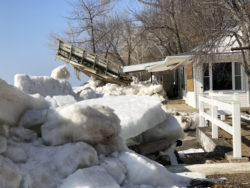
Ice vs deck erosion
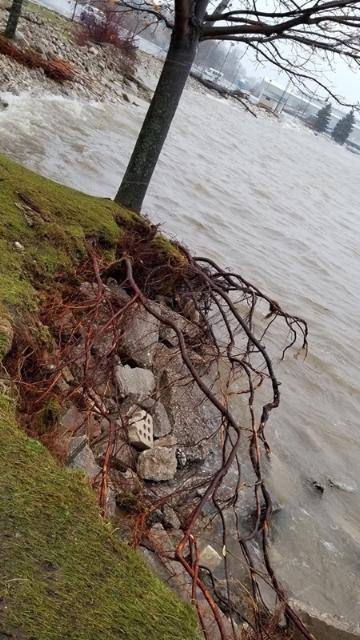
Shoreline tree roots exposed
Ice also pushes embankments, uprooting trees and lawns on small inland lakes. No matter how massive a tree is, the ice won’t slow down for it.
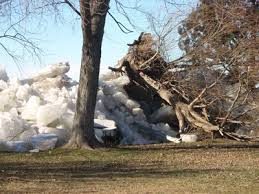
Ice Shove uprooting trees
In relatively small inland lakes, breaking waves can erode lawns away.
Headlands (points) usually have relatively high erosion rates. The waves, currents, and the ice will attack from all three sides. These attacks eventually transport the sediments to a new location where they settle in calmer weather.
Erosion is a normal process of nature.
Erosion and the redistribution of sediments is a natural process along shorelines. Typically, natural erosion proceeds very slowly. The plants and animals that live along the shore can adjust to these slow changes. They maintain a stable, healthy, productive ecosystem.
Accelerated erosion results when natural or human disturbances cause this equilibrium to be upset. Examples of this are higher than normal water levels and intense storms.
Human disturbances include vegetation removal, dredging, filling, or construction near the shoreline.
Another example of natural disturbances is large trees uprooted by a windstorm or a flood. When the soil becomes saturated with water, it weakens the soil around tree roots. The winds may uproot that tree.
IDENTIFY SERIOUS EROSION PROBLEMS
These are several signs of severe erosion problems. (Number one and three are significant)
- A large area of bare soil on a steep, high shoreline bank;
- A measurable change of the shoreline over time;
- Leaning or downed trees with exposed roots; and
- Large patches of muddy water near a lakeshore during periods of high water or following a rainstorm.
3 TYPES OF REACTIVE EROSION CONTROL METHODS:
Vegetative/No Mow: This method involves encouraging or planting trees or woody shrubs for the soil binding properties of their root systems. Grass and other plants will protect against raindrop impact and scouring from surface runoff.
Structural: This includes protective structures. The placement of rock of various sizes (rip-rap) has traditionally been the most effective and least expensive method.
Other structural methods include bulkheads, gabions (rock-filled baskets), and railroad ties. However, these methods are visually unappealing. They require more heavy equipment and technical expertise. These systems are more prone to failure than simple rip-rap. In addition, the DNR has disapproved of these methods in the past.
Manipulative: Mostly used on streams, this includes:
-
-
- Removing streamflow obstructions;
- Grading shoreline banks, or, in exceptional circumstances;
- Rerouting a stream channel.
Are there new techniques developed to prevent erosion?
A new soil preservation method called bioengineering has been proven successful.
Soil bioengineering combines mechanical, biological, and ecological concepts. These methods arrest and prevent shoreline erosion. An example is planting willows interspersed with rip-rap, where the rock provides immediate resistance to decay.
As the willows become established, roots invade and permeate the rock and underlying soil. They bind them together into an erosion-resistant mass. The willows also impart a more “natural” look to the shoreline.
Water levels are down; I don’t have to worry – Right??
This year, people do see water levels about 18-24″ less than in 2020. High water levels are the most significant contributing factor to shoreline erosion.
Will it stay down next year or in the years after? No one knows. In Las Vegas, that’s called a crapshoot.
What other factors affect my shoreline?
The next factor is the intensity of the storms. The Door County Peninsula had numerous high wind storms this year with up to 70 MPH winds.
A popular Marina in Sturgeon Bay: Skipper Bud’s Harbor Marina, located at the foot of the Michigan St. bridge, was a victim of a recent storm.
The marina had two of its five floating docks torn loose during a strong storm. Two tub boats quickly moved in place to prevent them from swinging into the bridge.
Are there other contributing factors to shoreline erosion?
You can expect water levels to rise rapidly when winds blow from the NW – NE direction for prolonged periods. This is despite the lower water levels this year. The stronger the winds, the higher the water will go. Waters south of Sturgeon Bay are particularly affected by these winds. In those areas, there are no other large outlets for the water to escape.
DO YOU NEED AN ESTIMATE FOR RIP-RAP?
Contact Dave@ 920-493-4406 or email at Dave@wisconsinpws.com.
What comes next?
Next week (on Aug 10, 2021), we will cover:
-
-
-
-
- Planning an erosion control project;
- Does erosion hurt my property values?
- What to expect for the cost of rip-rap.
Where is Pier & Waterfront Solutions?
Located at 7325 St. Hwy 57, it’s 3 miles south of Sturgeon Bay and 1 mile past the intersection of Cty MM (heading north). Look on the right side, one mile north, at the next corner (Idlewild Road and Hwy 57).
Is PWS OPEN?
The “Delta” variant is currently surging across the country.
Pier & Waterfront Solutions remains “open.” We have implemented measures to help protect the safety of our employees and visitors. PWS continues to work to maintain the trusted service that you have come to expect.
PWS implemented these preventive measures:
- Conducting as much business as possible by email, text, or phone.
- Site visits will continue.
- When in-person contacts are necessary, we follow “social distancing” guidelines.
- Our display yard is always open for you to examine at your leisure.
- All displays have a numbered, red tag on them. For more information, please reference that number.
What can YOU do to help us?
1. Conduct as much business as possible via emails, messaging, and emails.
2. When you see our crews installing equipment, please practice “social distancing.”
Thank you for allowing us to work with you.
YES – PWS is OPEN and waiting for you!
Please call, message, or email PWS with any questions.
Let’s all stay safe!
May 25, 2021
What dock dealer has your next dock?
Selecting the right dock dealer is the most important part of finding the right dock for your property. You need a dealer with experience and a great reputation.
How experienced is Pier & Waterfront Solutions?
The combined knowledge of our staff, some of whom go back over 25 years, means we have encountered virtually every type of situation on the Door County Peninsula. PWS selected only the best dock lines to handle.
Our goal is not to have the most locations, just the best equipment, trained employees and knowledgeable staff. The rest will take care of itself.
PWS has provided docks for small ponds, inland lakes, floating docks for soft, muddy bottoms, and standing docks for sandy beaches and large boulders. PWS docks range from lightweight aluminum to galvanized steel docks so heavy it takes a crane or All-Terrain Forklift to move them.
Rest assured, PWS offers the correct solution for your next dock.
What about the PWS reputation?
Talk to your neighbors. They usually know of all the dock dealers in Door County. In most cases, Pier & Waterfront Solutions will come up as the premier dealer.
Some products PWS offers come with a 15 year structural warranty. All of our products come with the backing of our years of knowledge and professional staff. PWS provides professional guidance when it comes to selecting your new pier or dock.
There are NO high-pressure salespeople at PWS.
PWS has installations along both sides of the Door County peninsula. We usually can find a close-by installation to assure you that we can handle your situation. PWS also uses satellite images to help understand your requirements.
PWS is the only dock dealer in the area who responded to the high water and strong storms of recent years, by providing rip-rap installations to protect your shoreline with our own crews.
Unique challenges
Each body of water has unique challenges for dock owners. Before considering a dock, we need to have an idea of what you are facing. That’s why we ask questions when you first approach us. We need to know the requirements you want.
The type of dock used in a sheltered area generally will not work on Lake Michigan waters. New to the area? PWS can make recommendations for the entire peninsula.
Experienced boaters will tell you the “Bay” conditions can change rapidly. The water could have a mirror-like surface at 11 A.M. and be a raging storm with 4′ waves an hour later. (See https://wisconsinpws.com/weather-radar-boaters/). That’s why you need the best solution for your location.
What about decking?
PWS offers a comprehensive range of decking – from wood to concrete to Flow-Through decking. Most decking comes in more than one color to meet your individual needs. Currently, the most popular colors are tan and gray.
Are there different dock widths available?
PWS offers widths ranging from 3′ to the legal limit of 8′ wide, depending on the style. Our most popular sizes range from 4′ to 6′ wide. In galvanized steel, the 5′ widths have become very popular.
Does Pier & Waterfront Solutions (PWS) do installations?
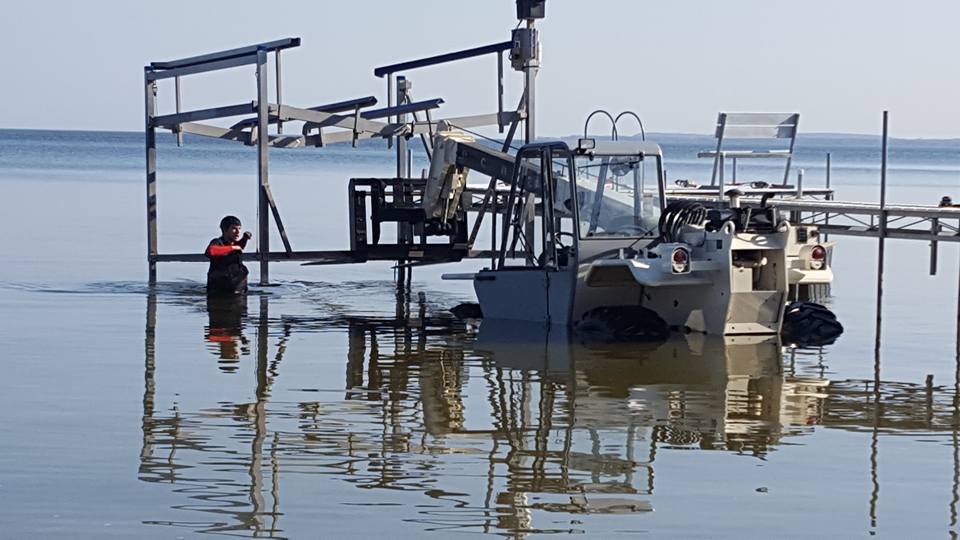
Lift & Dock installation
PWS has the widest range of equipment and the best reputation to handle your installation. We have (5) very dependable ATFs (All-Terrain Vehicles) capable of going into over 3′ of water. Our crew leaders are experienced and trained to handle every situation.
Don’t have beach access for our ground equipment?
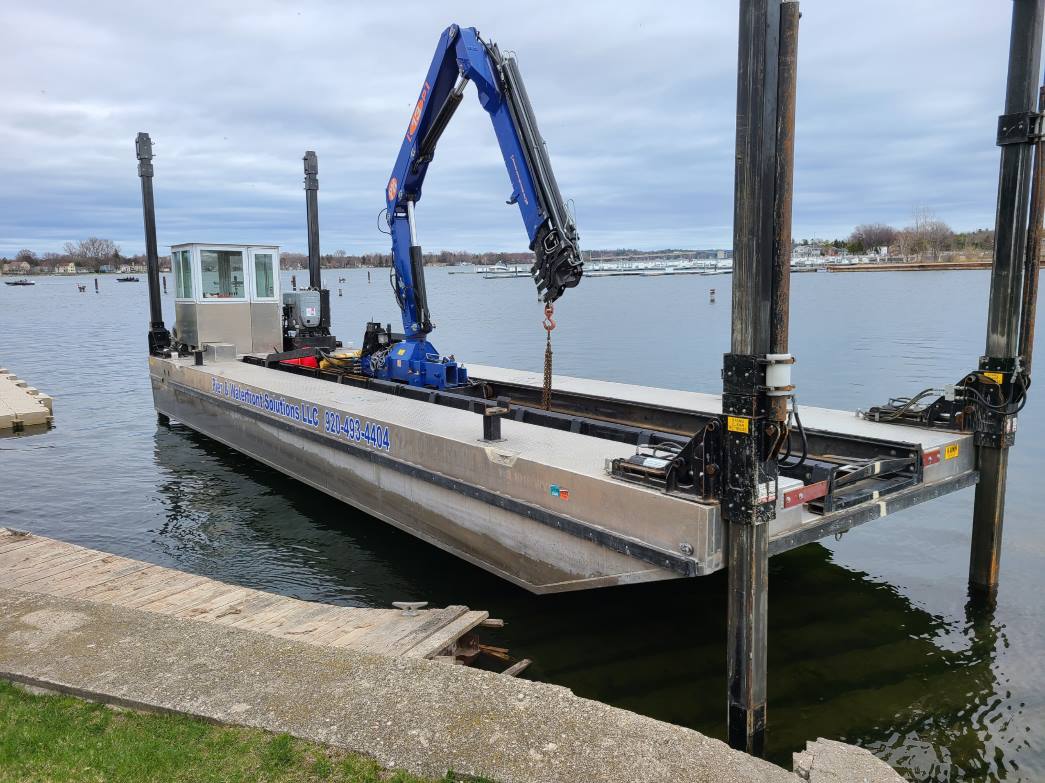
“Small Barge”
PWS features a 40′ barge equipped with a deck mounted, moving 60′ crane for installs and removals. The barge can pick up your dock or lifts and place them on top of most cliffs to protect them from winter ice damage.
Pier & Waterfront Solutions has you covered.
Where can you find Pier & Waterfront Solutions?
Pier & Waterfront Solutions, 7325 St. Hwy 57, is located 3 miles south of Sturgeon Bay. Go 1 mile PAST the intersection with County MM (heading north). Look on the right at the intersection of Idlewild Road and Hwy 57.
PWS is

Pier & Waterfront Solutions remains “open” year-round.
The Covid-19 virus is beginning to wane. We can only hope people will continue to get the vaccine to help slow this illness. We continue to conduct as much business as possible by email, text, or phone.
Site visits continue as usual. When making in-person contacts, we follow “social distancing” guidelines when possible.
PWS display yard – OPEN 24-7
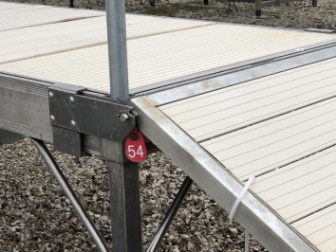
Red Tag
PWS‘s display area is always open for you to examine at your leisure. All displays available for sale have a numbered, red tag on them. Want more information on something you saw in our yard? Please reference that number when you inquire.
PWS provides estimates by email to make the process faster, safer, and paperless.
Call, message, or email Jerry with any questions.

Jerry Englebert
Contact Jerry at 920-493-4404 for more information or use this link.
May 4, 2021
May – Water Safety Month
Water Safety Month is here. With the start of Summer right around the corner, it’s time to start thinking about FUN IN THE SUN! You’ve been waiting for it – Now ENJOY IT!!
You want all your family and friends to be safe, and you would never allow an injury to occur. Let your family enjoy the entire Summer on the water! Here are some helpful tips to keep you in the sun all Summer long!
For Safety – Always wear a life jacket!
Whether you’re on a boat or a personal watercraft, always wear a personal flotation device for personal safety. Young children should always wear life jackets anytime they are in or on the water. A life jacket is the first line of defense against drownings.
They will insist that they can swim so they don’t need one. Can you ensure there will be no leg cramps or a head injury? Either of these would render them unable to “swim like the fish they think they are”? Don’t give in! YOU are the ADULT. Make them wear a floatation device for their safety.
Ensure that the life jacket fits snugly but comfortably. Make sure it cannot slip above the chin or ears when tugged on at the shoulders. Life jackets must be worn correctly to keep them safe.
Do you really want to find out what it’s like to lose a child, a friend, or a grandchild? Be the adult and insist they wear a life jacket.
Pay Attention to the Weather
Summer weather can change. Severe weather can crop up quickly and escalate even faster. For everyones safety, pay attention to weather forecasts and the skies. Don’t get caught on a lake when the weather goes from sunny to stormy.
Always wear sunscreen!
Today, we are all aware of the danger we incur when the sun is out. The reflection off the water and wet skin amplify the sun’s intensity. Protect yourself from harmful UV rays.
Drinking and Boating Don’t Mix.
A cool beverage can be refreshing on a hot Summer day but don’t drink and drive a boat. Consuming alcohol impairs your judgment. It slows your reflexes, making it harder for you to steer, swim and assist those around you. If you want to have a cool beverage, do it from the safety of the shoreline.
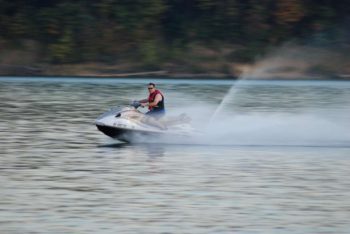
May-Water Safety Month
In Wisconsin, you will get a traffic citation for operating a boat while under the influence. Even using a PWC under the influence will get you a ticket.
Speaking of a PWC – everyone loves to race a boat or another PWC. It is easy to lose control and get thrown off the PWC. Maintain at least 100 feet from a dock and between any water vessel and 200 feet of the shoreline.
Read this state approved handbook – page 26 for additional regulations. A citation for operating in an unsafe manner will spoil your day.
A general rule of thumb is – if the state law does not allow you to drive a vehicle in that manner – it’s probably illegal on the water too.
For safety – Keep Your Speed Down and Pay Attention
The lakes and waterways can get very busy in the Summer months. Watch out for other boats, swimmers, tubers, and skiers. Maintain a safe speed and always practice defensive driving. Not sure what the other guy is going to do? – stay clear!
Keep an eye out for boats and swimmers in distress.
Use the Buddy System for Safety
Bring a buddy with you – it’s more fun and safer! Even experienced swimmers can get into a dangerous situation and need help.
Make National Water Safety Month an excellent experience for everyone.
Where can I find Pier & Waterfront Solutions?
Pier & Waterfront Solutions, 7325 St. Hwy 57, is located 3 miles south of Sturgeon Bay. Go 1 mile PAST the intersection with County MM (heading north). Look on the right at the next corner – Idlewild Road and Hwy 57.
Pier & Waterfront Solutions remains “open” year-round.
The Covid-19 virus continues to spread and affects many people. We are conducting as much business as possible by email, text, or phone.
Site visits continue as usual. When making in-person contacts, we follow “social distancing” guidelines when possible.
PWS display yard – OPEN 24-7
Red Tag
PWS‘s display area is always open for you to examine at your leisure. All displays available for sale have a numbered, red tag on them. Want more information on something you saw in our yard? Please reference that number when you inquire.
PWS provides estimates by email to make the process faster, safer, and paperless.
Call, message, or email Jerry with any questions.
Jerry Englebert
Contact Jerry at 920-493-4404 for more information or use this link.